It’s easy to associate hanging systems with framed art only. But when your brief calls for temporary panels, acrylic sheets, thin wood, foam board, or mixed media, standard frame hardware falls short. That’s where Utility Hooks and Panel Hooks shine. They give you a clean, secure grip on flat substrates, with no fasteners attached to the panel itself, so you can change content often without patching holes or damaging your pieces.
If you’re already working with a track (including a display reveal or traditional surface rail), these hooks drop onto your cables/rods and instantly turn the wall into a modular panel system.


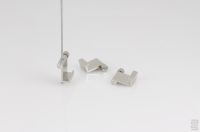
Typical setups: Utility Hook

Utility-Backed Frames:
Hook behind a notch without touching the wall finish

Utility-Backed Frames:
Hook behind a sawtooth without touching the wall finish

Institutional Install:
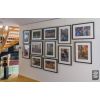
Brigham Young University uses Utility Hooks for robust, repeatable displays in educational environments
Typical setups: Panel Hook

Sandwich Method:
Place a Panel Hook at the top and another at the bottom. The upper hook bears the weight, the lower hook keeps the panel plumb.

Tensioned Display:
Use a floor-to-ceiling (or wall-to-wall) cable run and clip multiple Panel Hooks at consistent intervals for a crisp “floating” grid

Acrylic Sheets:
Pair Panel Hooks with clear acrylic to create sleek info boards in conference rooms or real-estate offices
 What they are - and when to use which
Utility Hook
- Best for: Lightweight substrates up to 3/16 in. thick; panels with notches; frames with sawtooth hangers.
- Why pros love them: They grasp from the back edge or recess, so signage or frames can hang flush with an ultra-discreet look.
- Real world: Classrooms that rotate student work, corporate project boards, wayfinding mockups.
(Utility Hooks support panels up to 3/16 in.; excellent for sawtooth-backed frames.)
Panel Hook (Single or Double-Sided, Standard or Wide)
- Best for: Thicker media up to 5/8 in. and multi-panel compositions.
- How they work: The panel is “sandwiched” between a top and (optional) bottom hook - no holes, glue, or screws in the panel.
- Two-sided display: The Double-Sided version lets you show content on both faces (ideal for windows, atriums, corridors).
(Panel Hooks available in Single Sided, Double Sided, and Wide widths to accommodate panel thicknesses.)
Why hooks beat adhesives for panels
Adhesive tabs and strips are quick, but they’re single-use and can fail with heat, uneven texture, or heavier panels. Trade guides for foam board, for example, often steer users toward purpose-built hangers or hardware over general adhesives, especially for repeat change-outs.
By contrast, hook-based panel hanging:
- Protects the panel
(no drilling/screwing the substrate) - Protects the wall
(no patch-sand-paint) - Scales easily
for grid layouts and vertical stacks - Reconfigures in seconds
slide the top hooks up the cable, remove the panel, drop the new one in place
Step-by-step: from blank wall to professional panel display
1. Plan the sightline
For walls with mixed frames and panels, aim to center most pieces around 57–60 in. above the finished floor, an industry guideline that keeps galleries and corridors feeling balanced. Architectural DigestBetter Homes & Gardens
2. Pick your droppers
Choose stainless cable for maximum capacity and a technical look, or clear cord where near-invisibility is preferred. (Rods are great for museums or when anti-theft fittings are required.)
3. Select the hook type
- Up to 3/16 in. Use Utility Hooks (or sawtooth-backed frames).
- 3/16–5/8 in. Use Panel Hooks (Standard or Wide as needed).
- Two-sided content? Choose Double-Sided Panel Hooks.
4. Sandwich the panel
Install the top panel hook and seat the panel. Add a bottom panel hook (or two if the panel is wide) to prevent sway and keep the face vertical.
5. Micro-adjust for level
Self-gripping hangers on the cable let you nudge height in millimeters for dead-level rows. (Pro tip: sight across the bottom edges, not the tops, to avoid visual “step-downs” with different panel thicknesses.)
6. Swap in seconds
To refresh content, simply slide the top hook up, remove the panel, and drop the new one into the exact location. No re-measuring, no wall repair.
Where Utility & Panel Hooks excel
- Traditional picture rails are historically used to avoid wall damage while allowing frequent rearrangement, now you can achieve that flexibility with modern cables/hooks as well.
 Corporate & Civic:
Conference rooms, municipal lobbies, capital projects boards, donor recognition
 Education:
Rotating student portfolios, STEM posters, temporary exhibits
 Retail & Real Estate:
Seasonal campaigns, bay headers, property boards with interchangeable acrylics
 Museums & Galleries:
Study drawings, ephemera, didactics, where fast swaps and non-invasive mounting matter
Specs & compatibility
(at a glance)
- Utility Hook capacity:
For panels up to 3/16 in.; also ideal behind sawtooth hangers. - Panel Hook capacity:
For panels up to 5/8 in.; Single-Sided, Double-Sided, Wide versions available. - No panel fasteners required:
Panels are clamped/sandwiched, leaving them unmarked. - Pairs with any standard cable/rod rail
(including installations that feature a display reveal track line).
FAQs
(inspired by common forum/Reddit questions about foam board & panel hanging) 
- Will hooks deform foam board?
Not when sized correctly. Use Panel Hooks for thicker foam board (up to 5/8 in.) and Utility Hooks for thin media (+-3/16 in.). Many trade guides recommend hardware-based approaches for foam board over adhesives if displays change frequently. - How do I keep panels from tilting?
Use a bottom panel hook as a stabilizer (or two on wide panels). If you’re hanging frames with sawtooth, a small utility hook placed behind the notch keeps the face plumb (see “Utility hooks are perfect at hanging from a sawtooth”). - Can I combine panels and framed pieces on the same wall?
Yes. That’s the beauty of cable/rod systems - mix substrates freely and adjust spacing without new holes. For sawtooth frames, see pro tutorials on measuring and anchoring technique. - What about historic interiors with picture rails?
Picture rails and hooks are a time-tested, wall-friendly method dating back over a century - the goal (damage-free flexibility) is the same as modern cable/rod systems.
Why AS Hanging Display Systems
- Full ecosystem
Rails, cables/cords/rods, Utility Hooks, Panel Hooks, security accessories. - Non-invasive
Panels remain unmarked; walls stay pristine. - Fast visuals
Install a modular layout once; swap content in seconds. - Expert help
From load/spacing to spec sheets for procurement, our team is here to advise.
If you have questions, or wish to learn more on how you can improve your next design project, please contact our Customer Support at [email protected], or give us a call at 866 935-6949 (toll free) or at our local number 450 619-7999.
When you hang with AS Hanging Display Systems, you Hang with the Best®.
Explore our Picture Hanging Systems built of tracks, cables and hooks.
We offer picture hanging hardware for your residential, commercial and institutional projects.