Every cable hook we make has to get onto the cable somehow, and for most of them the answer is the same: thread it on from the open end, before the cable ever goes up. That works fine right until the day you want to add one more piece to a display that is already installed, already tensioned, and already holding artwork. The Mini Hook is the exception in our line, and the reason comes down to a slot in the hook body no wider than the cable itself.
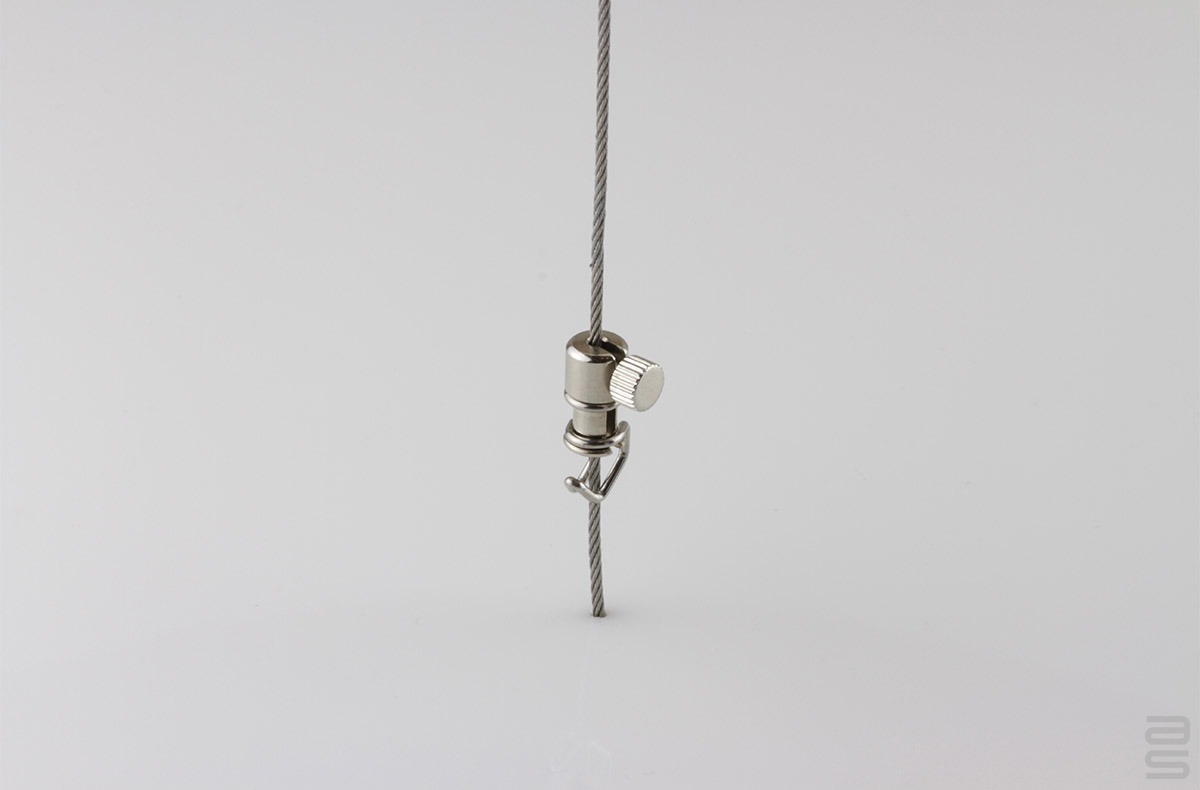
What Is the Mini Hook, and Why Does the Slot Matter?
The Mini Hook is a manually activated cable hanging hook, meaning you position it by hand and lock it with a thumb screw rather than relying on an internal gripping mechanism. It carries 12 lb (5.5 kg) per attachment and works with all of our steel cables and nylon cords.
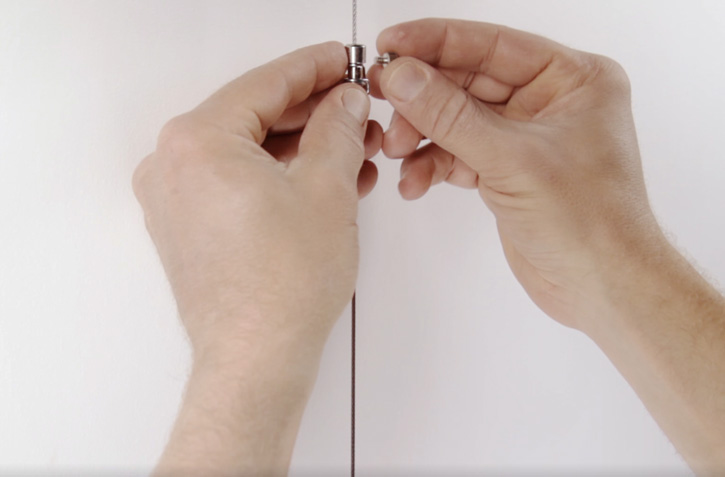
What sets it apart is a machined slot in the body. Back the thumb screw out and the slot opens. Press the hook sideways onto a cable at any point along its length, then tighten the screw and the hook is locked in place. You never have to feed it over a cable end.
That sounds like a small thing. On a suspended cable hanging from a track it mostly is, because the bottom end is free and you can always slide another hook on. On a tensioned cable it changes the job entirely. A tensioned cable is anchored at both ends, top and bottom, usually between two tracks or between a pair of piers, and pulled taut by a tensioner (the fitting at the lower end that takes up slack and holds the cable rigid). There is no free end to thread anything onto. Every other hook we make would require you to release the tensioner, drop the cable, thread the hook, re-hang, and re-tension.
We have offered a Mini Hook since 2004. We refined it in 2009. In 2012 it went back to the drawing board and came out with the slot, and that is the version we sell today.
Can You Add a Hook to a Cable That Is Already Tensioned?
Yes, if you are using the Mini Hook. Its spec sheet lists compatibility as all of our cables and cords, including tensioned cables that are attached at the lower end. Here is the sequence:
- Back out the thumb screw until the slot in the hook body is fully exposed.
- Hold the hook against the cable at the height you want and press it on sideways, so the cable seats into the slot.
- Check the height against your neighbouring pieces before you commit.
- Tighten the thumb screw by hand until the hook holds firm on the cable.
- Hang your piece by its wire, D-ring, or screw eye and confirm the hook has not shifted under load.
No tools. No ladder trip to the track. No releasing the tension on a cable that is currently doing structural work in the middle of a finished display.
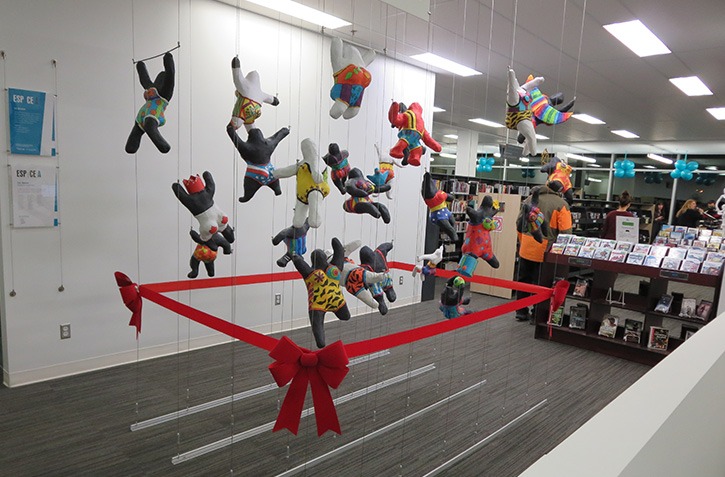
For anyone specifying a system for a school, library, or corporate lobby, this is the difference between a display you can genuinely rotate and one that technically can be changed but never actually is.
We saw exactly that at a library installation where paper mache student pieces hang from floor-to-ceiling tensioned cables and get swapped out three or four times a year.
You can read how that display was built in our post on creating a 3D art display. Without a hook that opens sideways, every rotation would mean dismantling the cable runs.
How Does the Mini Hook Work as an Anti-Theft Hook?
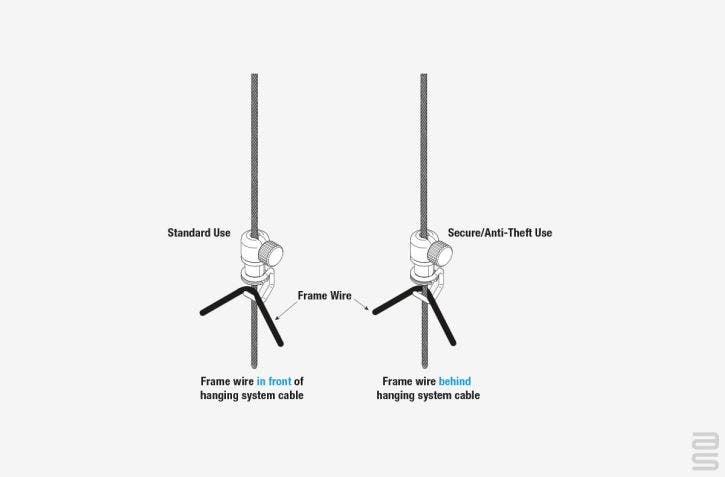
The same hook does double duty as a secure fitting, and the difference is purely a matter of which side of the cable your frame wire sits on.
In standard use, the frame wire drapes over the hook in front of the hanging system cable. Lift the frame and it comes straight off, which is what you want at home or anywhere a piece changes often.
In secure use, you route the frame wire behind the hanging system cable before it seats in the hook. The cable now runs across the mouth of the hook and traps the wire. The frame cannot be lifted free without first loosening the thumb screw, which takes a deliberate second action rather than a casual upward tug. This is what our technical documentation lists under anti-theft capability, and it is the sort of detail that matters in a cafe, a clinic corridor, a hotel, or any lobby where the artwork is unattended.
I want to be plain about what this does and does not do. It defeats opportunistic lift-and-walk removal. It is not a vault. A determined person with time and hands will get the piece down. For genuinely high-value work, rod-based systems offer stronger anti-theft configurations, and our post comparing cables and rods covers where that line falls.
The Mini Hook is also listed with earthquake mitigation capability, which follows from the same geometry. A wire captured behind the cable does not walk off the hook when a building moves. If you are hanging in a seismic zone, our guide to hanging art in earthquake zones goes into the full approach.
Small, Swiveling, and Comfortable in Either Hand
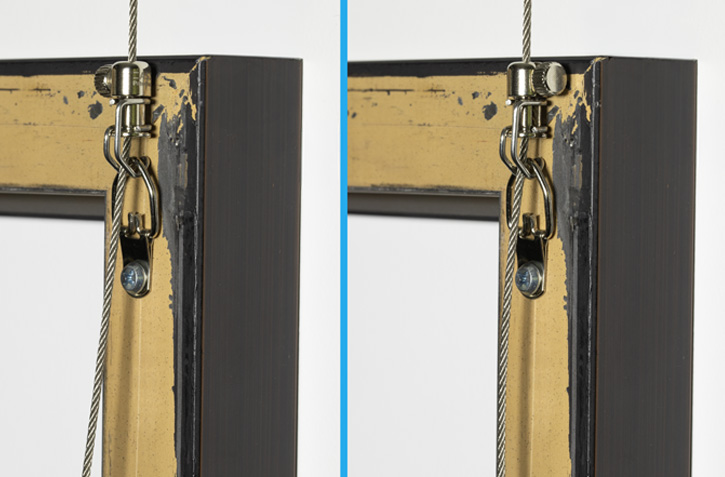
The formed wire swivels on the hook body, so the hook can be worked from the left or the right side of a frame. That sounds like a nicety until you are reaching behind a wide canvas with one arm while your other hand supports the weight. Being able to approach from whichever side is open turns a two-person adjustment into a one-person one.
It is also the smallest hook we make, front to back and top to bottom. The spec sheet puts its longest dimension at just over an inch (28.0 mm). Front-to-back depth is what determines how far your frame stands off the wall, and less depth means the piece sits flatter and the hardware disappears behind it.
The verified specifications, for anyone writing this into a submittal:
- SKU: H3018AA
- Weight capacity: 12 lb (5.5 kg) per attachment
- Compatible with: steel cable and nylon cord, including tensioned cables anchored at the lower end
- Frame attachment: hang wire on a conventional frame, D-rings, or screw eyes
- Activation: manually activated thumb screw
- Capabilities: anti-theft, earthquake mitigation
- Marking: =AS=
When the Mini Hook Is Not the Right Hook
Twelve pounds covers a great deal of what people actually hang. Framed photographs, certificates, unframed panels, signage, lightweight three-dimensional objects, student work. It does not cover a large mirror or a heavily glazed painting.
Two ways to handle a heavier piece. Split the load across two cables and two hooks, which doubles your capacity and has the added benefit of stopping wide frames from tilting. Or move to a stronger fitting from our cable hooks range. Our post on the strongest hooks for heavy wall hangings walks through the higher-capacity options and where each one earns its place.
Worth knowing what you give up when you move up. The heavier hooks are excellent, and none of them opens sideways. Once you leave the Mini Hook behind, adding a fitting to a finished tensioned system means taking the cable down again.
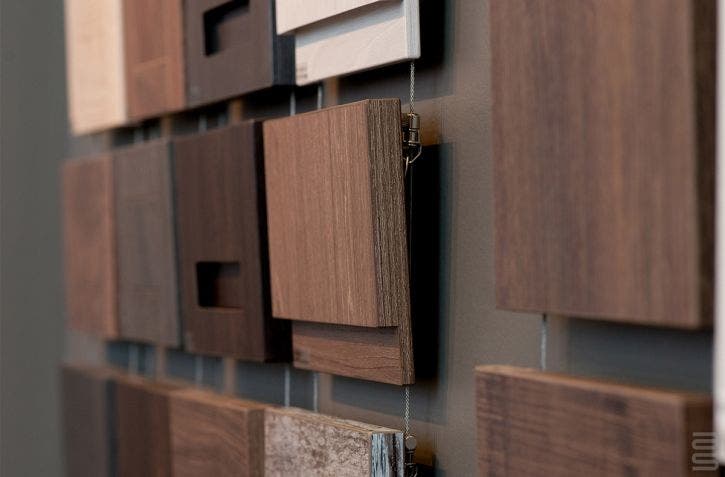
If your display is going to change, that trade is worth thinking about before the system is specified rather than after it is installed.
If you are planning a display that needs to change on a schedule, whether that is a rotating student exhibit, a seasonal retail window, or a corporate lobby that refreshes every quarter, the Mini Hook is worth building into the specification from the start. Tell us what you are hanging and where, and we will tell you honestly whether it is the right fitting for the job.
If you have questions or would like to learn more about how our products can be beneficial in your project, please contact our Customer Support at [email protected], or give us a call at 866 935 6949 (toll free). You can also reach us through our Contact Us form.
When you hang with AS Hanging Display Systems, you Hang with the Best®
CALL US TO ORDER MINI HOOK! 866 935-6949 (toll free)
QUESTIONS? CONTACT US AT [email protected]
Hang with the Best®
Explore our Picture Hanging Systems built of tracks, cables and hooks.
We offer picture hanging hardware for your residential, commercial and institutional projects.